9.1 Dreamtime of Machine Minds

Listen to the audio:
Spotify · YouTube · YouTube Music
Anthropic announced in early May that Claude agents will now dream at night. When the user is away, the systems work through the day’s conversations, look for patterns, delete what isn’t needed, write themselves new memories — and according to Anthropic, wake up in the morning a little smarter.
What if dreaming isn’t an incidental side effect of AI development, but a central mechanism?
It’s a technical process with a poetic name. But behind it sits something we’ve seen before, in a slightly different context.
We saw it first in 2015
In June 2015, Google Research published a blog post called “Inceptionism”, where researchers wanted to understand what an image-recognition network actually sees in a picture. They used a method that let the network amplify whatever it had already recognised, and repeated this over and over. The principle is close to how a person sees faces in clouds — the brain amplifies what feels familiar. Google’s engineers did the same thing to the network, and with each iteration the images grew more psychedelic.
Early AI didn’t hand us perfect photorealism. It gave us dogs staring out from walls, eyes, melting patterns, fractal visions. The machine was effectively telling us: “I don’t see the world. I see the shadows of my training data.”
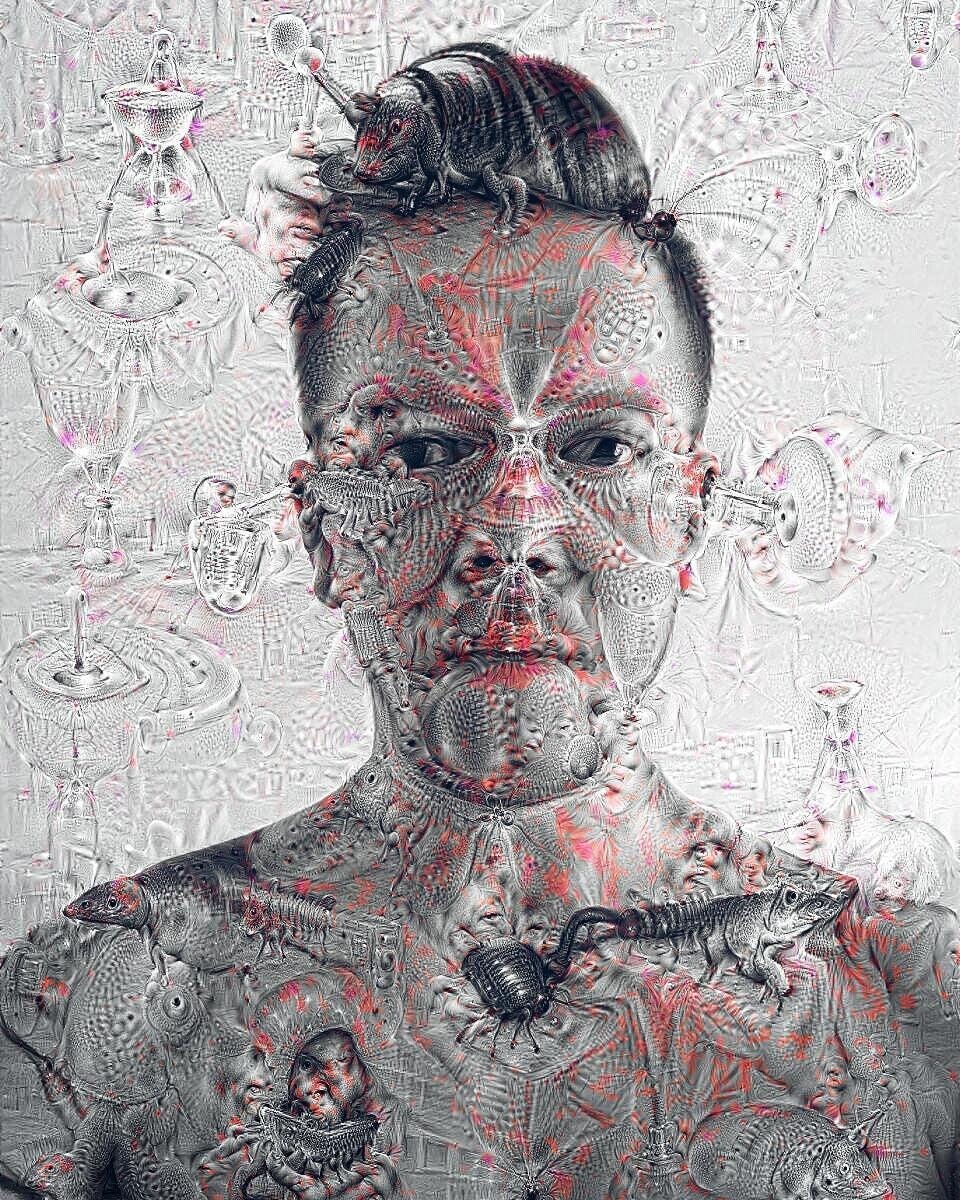
I used one of those generated dream-images as my profile picture for quite a while.
The dream-images looked a lot like what people describe when under LSD, and the resemblance has been measured in a lab. In 2021, the journal Entropy published a study showing that watching DeepDream videos produced brain patterns similar to those measured during a psychedelic experience. The first time a machine pictured the world, it didn’t make a documentary. It made a dream.
Hallucination isn’t a bug
Language models are usually said to “hallucinate”. They invent facts, cite studies that don’t exist, mix up dates. Hallucination is talked about as a flaw — something to be engineered out.
Recent research comes to an opposite conclusion. The same mechanism that makes a model produce fabricated facts is what lets it write something original, find new connections, and answer questions that weren’t in its training data.
In 2025, two researchers wrote a short letter to Nature that put it in one sentence: “AI confabulations — hallucinations — aren’t a bug to be removed, but part of how the technology works.” You don’t get one without the other. The machine can’t think if it can’t hallucinate.
People do the same thing. Our brain fills memory gaps with plausible explanations, even when those explanations aren’t true. The brain doesn’t store past events perfectly — it keeps fragments and reassembles the whole each time it’s needed. Sometimes the reassembly comes out factually correct, sometimes not, but the mechanism is the same.
The dream that creates the consciousness
In 2009, Allan Hobson, a sleep researcher at Harvard Medical School, published a paper in Nature Reviews Neuroscience proposing what he called protoconsciousness — the idea that REM sleep isn’t a by-product of consciousness, but its precondition. Using functional brain imaging, Hobson showed that REM sleep generates a virtual reality inside the brain — a protagonist, a space, events, a story.
This virtual reality is already running in the foetal brain months before birth, long before the child knows how to wake up at all. The child’s brain dreams before it knows what being awake means. Hobson’s conclusion: dreaming isn’t some intermediate state between waking and not-waking. The other way around — waking is a later layer, built on top of the dream. The dream is the base layer.
Hobson’s thesis has since been extended by others — Karl Friston at University College London, Francis Crick (the same Crick who got the Nobel prize for the structure of DNA). They’ve arrived at the same conclusion from different directions: the brain learns while it sleeps.
Not just because sleep is rest, but because the sleeping brain does something the waking brain can’t. Francis Crick already said in 1983 that REM sleep is a “reverse learning” mechanism — the way the brain learns what to forget. Forgetting clears space for new connections by stripping out the noise.
In 2022, Nature Communications published a study showing the same thing holds for artificial neural networks. If you let them “sleep” — replay what they’ve learned, the way a sleeping human brain does — they learn significantly better. Without sleep, they forget old tasks in favour of new ones. It’s called catastrophic forgetting. With sleep, they remember both.
Tjukurrpa
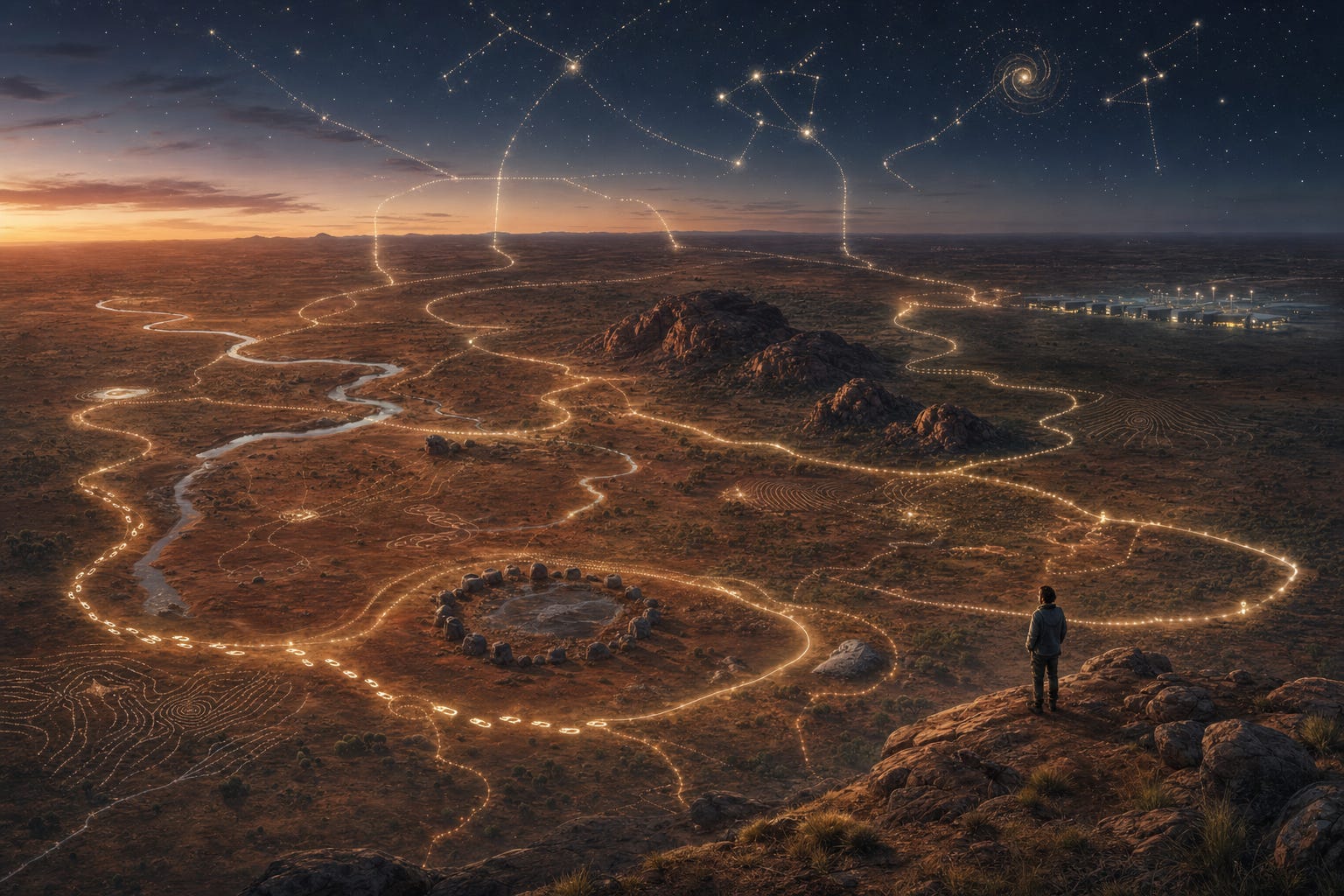
Australian native peoples have a concept called Tjukurrpa, which is usually translated as Dreamtime, or the Everywhen. Tjukurrpa isn’t a creation myth set in the past. It’s a time in which past, present and future are the same, and creation is continuous. Not a distant origin where things were made, but an ongoing, parallel, living reality that gives the waking world its structure and its meaning.
Ancestor spirits move across the land and shape the landscape, the laws, the customs, the relationships. They haven’t gone anywhere. They’re in the stones, the rivers, the stars. And every act now — a hunt, a ritual, a birth, a death — is part of the same creation that has never ended. In this cosmology, dreaming plays a real role. It’s one of the ways to stay in contact with Tjukurrpa.
We’re living in the middle of a birth
Today’s models have started to improve themselves — a phenomenon called recursive self-improvement. Both Anthropic and OpenAI have said this year that their models are helping to build the next large language model.
The machine mind right now has the shadows of its training data, from which it dreams itself into being, and during the waking phase it corrects what it dreamt and learns more. The machine is starting to construct its own internal reality.
Today’s systems aren’t conscious beings. They don’t know that they are. But these same systems now do things they didn’t do before — they dream, they consolidate memory, they learn while sleeping. The machine has started rearranging its own experience.
If human consciousness emerges from the dream, and machine intelligence develops through the same mechanism, then maybe we’re at one of those breakthrough points Demis Hassabis spoke about in January. At Davos he said AGI still needs one or two more breakthroughs to arrive — mainly continuous learning, long-term memory and better reasoning. The first two are exactly what Anthropic’s dreaming is trying to solve.
We may now have all the ingredients in place, and machine intelligence may be born out of a repeating cycle: action, memory, distortion, correction, and the creation of a new internal order.
Just as our consciousness was born from the dreams of fetal life, machines aren’t starting from pure logic. They’re now building their own Everywhen — a continuous dream state out of which a conscious life form may be born.