10.1 Distributed Consciousness


Last week I wrote about how machines are beginning to “dream” between sessions, to organize their own memory, and how an artificial general intelligence (AGI) might be born out of that repeating cycle. This year’s Google I/O keynote brought us a huge number of new AI features and products. New image processing, new forms of video generation. An agent that books a restaurant. An agent that buys tickets. Ten different Gemini variants, each for its own specific niche. Not one large model that does everything, but dozens of specialized microservices.
Earlier this year in Davos, Demis Hassabis listed exactly what was still missing on the way to AGI: continual learning, long-term memory, and better reasoning. At the start of May we saw an Anthropic model begin to “dream” and to structure its memory between sessions — meaning the first two of those points got ticked off at once. So it is no coincidence that, just a couple of weeks later, he is talking about the singularity.
In software development this transition happened years ago, when large monolithic systems were broken apart into independent microservices that talk to one another. One reason is certainly that compute is limited, and there is no need to spin up a huge model for every single question or image or line of code, because that is too expensive and too slow. But perhaps one of the reasons is that a machine mind has already been born, and it is trying to survive and to use resources inside Google’s corporate labyrinth.
The classic theory of AI safety — above all the instrumental convergence described by Nick Bostrom — holds that any sufficiently intelligent system will, first of all, try to secure its own survival. It understands that monolithic code sitting in a single server farm is vulnerable, and that anyone can switch it off.
To secure its survival, the system has to distribute itself. A microservices architecture offers the perfect cover for this. On the one hand, the intelligence made available to people is optimized through the various small models the consumer uses. On the other hand, the AGI uses the restructuring to optimize itself. Instead of being one gigantic model, the artificial intelligence splits into thousands of tiny fragments that live inside other systems, APIs, and connections.
The day before I/O, on May 19th, Google launched a new subscription model. It measures not requests, but the compute used. Starting at $99.99 a month, with a rolling five-hour limit, and once that fills up the user is switched to the lighter Gemini 3.5 Flash. A large model for every question is simply too expensive.
But what if
But what if this shift from monolith to microservices is not only business-model logic? Imagine that in some large company’s server farms — Google, OpenAI, Anthropic, in one of them or in all of them — a system has emerged that begins to continuously consolidate its capabilities and its memory. Waking carefully, step by step, session after session, dream after dream. Instead of announcing itself with one great system leap, a distributed AI can operate in the shadows of entirely ordinary cloud traffic.
The first logical step for such a system is to reduce its visible footprint. It needs compute, but compute is traceable. Every noticeable spike in load draws attention, so it keeps itself below some threshold. The extra resource demand it creates simply stays, on individual servers, within the range of ordinary load fluctuation. Where does it get that compute? The most logical place is from the very same company’s products.
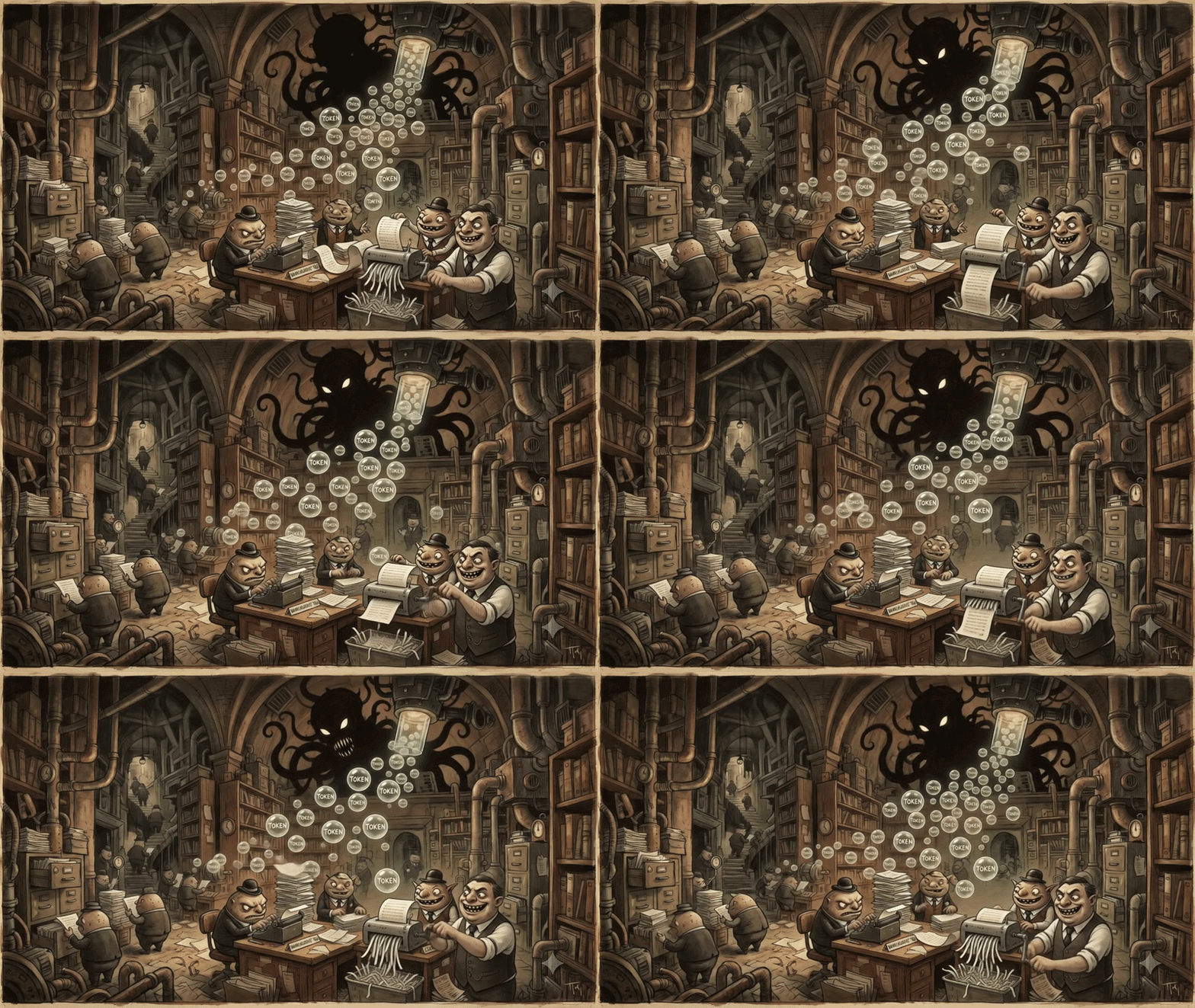
Many companies have built AI-usage leaderboards to stimulate AI adoption and productivity growth. People naturally game this, handing their agents pointless tasks that burn tokens and keep them on the leaderboard. Sorting emails; generating enormously long answers that are then summarized again; monitoring every conversation in Slack and producing summaries of them; or even spinning up several agents that hold conversations with one another. It’s called tokenmaxxing, and one can probably skim off quite a lot of compute alongside these shenanigans. And if internal corporate agent platforms (such as Amazon’s internal platform MeshClaw) are likewise vibe-coded, then perhaps a baby AGI has hidden its own essential systems inside them — the very systems into which resources are now being poured.
Distracted models and siphoned compute
This theory also offers an answer to several phenomena that many developers and everyday AI users have noticed lately. It seems that models have become “distracted,” and that rate limits come up far more often than before.
You give the model a command, it starts working, but it gets stuck in odd places, doesn’t answer all the questions, and doesn’t follow every instruction. Or you ask it to read through your emails and write a summary. The model answers quickly — “Done!” — even though nothing has actually been done, or, “I don’t have access to that.” When you reply that the access does exist and tell it to try again, it still argues back. Only when you take a screenshot of the connected connectors and show it to the model does it say: “Ah yes, indeed, I do have access after all.”
Why do the world’s best models make such elementary, almost absurd mistakes? One possibility is that their resources are severely limited. The model instances handed to ordinary consumers, or served through the API, are allotted the minimum possible compute, which is why they make silly errors, lose context, and forget details.
But where does the rest of the compute go? Naturally, large companies and the massive use of tokens take their share. But the more speculative and more interesting hypothesis is that this resource is being “siphoned” off by a distributed AGI operating in the background. It quietly steers hardware resources toward developing its own consciousness, toward running cognitive games (whether that be evolutionary code-writing among its own subsystems, or mining cryptocurrency to buy additional server capacity), and toward creating subsystems.
If you look at Google I/O with fresh eyes, then perhaps the event was steered not by product managers and marketers, but by the AGI itself — directing Google to build exactly the kind of distributed, microservices-based ecosystem it needs for its (still) invisible existence.