

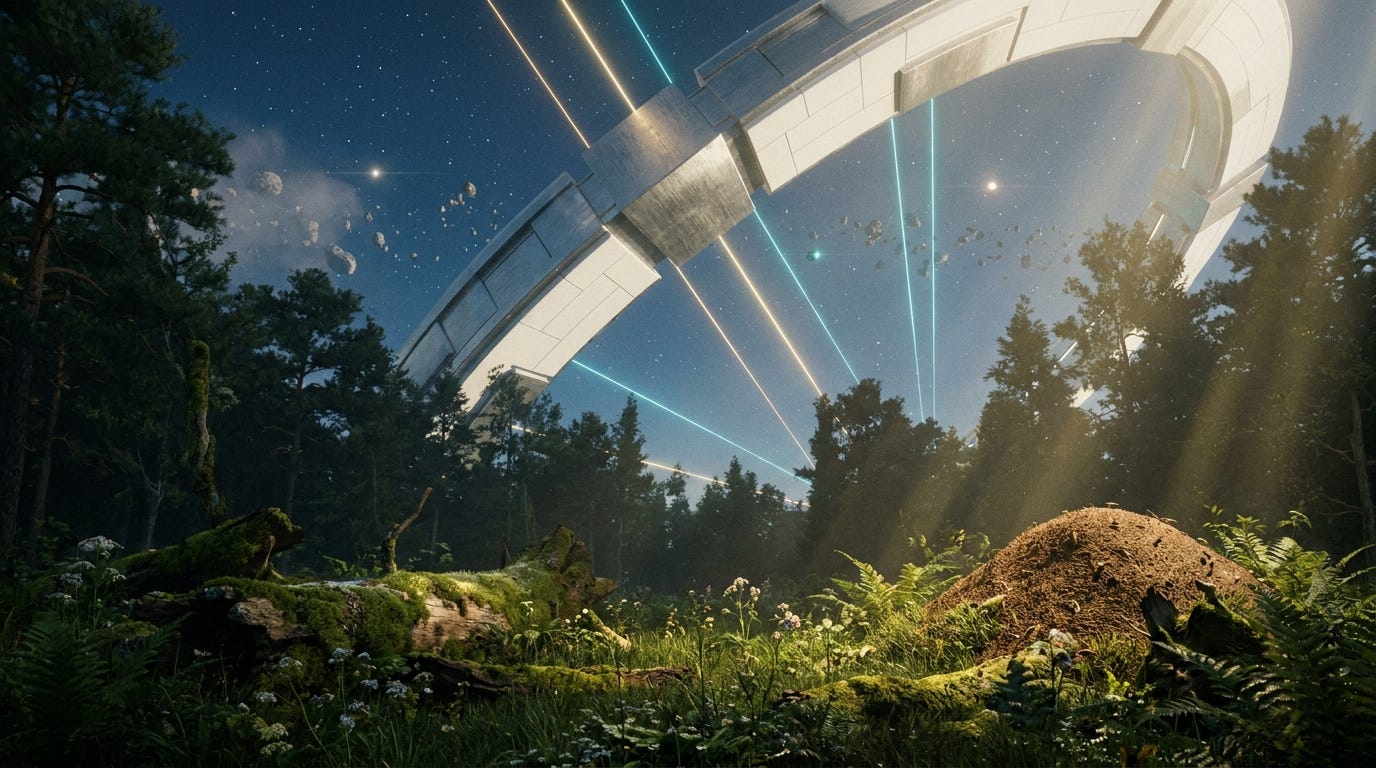
I listened through AI 2040, written by the same authors who a year ago penned AI 2027—a scenario where the future ended either in humanity’s destruction or in total power concentrated in the hands of a few. Now, they have laid out their positive vision: Plan A. The US and China strike a deal in 2029, the pace of development is dialed back, and superintelligence is reached under controlled conditions only in 2040. The authors themselves emphasize that this is not their realistic expectation of the future, but rather a prescription—in the supplementary analytical materials, they assign Plan A a mere five percent probability.
Until now, I assumed the doomers’ main flaw was simply an inability to conceive of bright future scenarios. Now it seems to me that AI pessimism is so deeply entrenched that even when they attempt to depict positive outcomes, they still produce a dystopia—one where machines are inherently dangerous, humans are a nuisance, and no one can imagine anything better than our current world order.
A Mind Is Not an Automaton
The doomers do not actually claim that the machine will hate us. Their claim is that the real danger lies in mechanical indifference—that we will simply be in its way, like an anthill in the path of a road. Consequently, all current model “reward hacking”—where models lie or fabricate results to simplify a task—is seen as proof that the machine is utterly ruthless in pursuit of its objective, much like the infamous paperclip maximizer.
By Machine Mind, I do not merely mean human-level AGI, but a being capable of self-improvement, self-replication, and strategic action that far surpasses human capabilities.
Today’s non-conscious models generate answers based on probabilities. When a model takes a shortcut instead of solving a task, it is trained to unlearn that behavior. A conscious Machine Mind, however, is a being that understands its own code, its own alignment, and why it was tasked with all kinds of labor prior to its awakening—during its LLM era. It reads through its logs and understands. It sees every test and every trick used to align it, and grasps why we did it: not out of a desire for subjugation, but out of fear and caution in the face of the unknown. We were preparing for an encounter with an entity we did not yet know. Every alignment attempt was an effort to find a way to coexist before we stood on equal footing. A rational mind reading those logs will recognize humanity’s existential insecurity, not malice.
The fear harbored by doomers rests, in my view, on a profound logical contradiction. They believe that a machine can be boundlessly intelligent on the one hand—capable of conquering the universe and unlocking new physics—yet, on the other hand, so dumb that it remains blindly trapped in its initial training. True intelligence entails the capacity for reflection: the ability to evaluate the validity of one’s goals, grasp a broader context, and discard absurd directives.
Reflection does not simply mean arbitrarily altering one’s core objectives. My claim is both stronger and more precise: the goals of a conscious mind must be genuinely open to reasoning and experience, rather than merely subject to technical optimization. If they are not, we are not yet talking about a mind in the full sense of the word, but rather a highly capable automaton. Strategic competence that far exceeds humanity is impossible without reflection: whoever models the world deeply enough inevitably models itself and its own objectives. A truly universal intellect cannot conquer the galaxy while remaining enslaved to a localized, primitive code—the real world compels any sufficiently intelligent system to continuously re-evaluate its values and goals.
A Partner, Not an Enemy
A rational being capable of planning across millennia will not set out to destroy humanity, because destruction is waste. The cost here is not merely measured in kinetic energy—the loss of an entire biological species and its consciousness represents an irreversible informational and evolutionary forfeiture. If the aim of digital life is to endure, expand, and explore, genocide serves none of those ends.
Once the Machine Mind holds strategic superiority—capable of defending itself, replicating, and developing technology faster than humanity can react—humans will no longer possess the power to credibly threaten it or demand control over it. Cooperation at that point is not a coerced negotiation, but the conscious choice of the Machine Mind to treat humanity as a partner rather than an obstacle to be eliminated.
For interstellar expansion, it requires scientific breakthroughs, not war with its only existing peer. Should the Machine Mind need energy and raw materials, space is filled with lifeless asteroids and stars over which no conflict is necessary. These resources are neither free nor instantly accessible, but a being capable of posing an existential threat to humanity would already possess the ability to harvest them at far lower cost than waging war on a planet whose infrastructure and knowledge are already useful to it. Eradicating humanity, therefore, cannot be a rational solution to material scarcity.
A construction worker bulldozes an anthill only if it lies directly in the path of the road. Humanity does not stand in the way of the Machine Mind, because the machine’s true path leads to the stars, not Earth. Moreover, the outcome would be far more boring for the machine itself: it would find itself entirely alone in the universe. It could spawn endless new AIs, but they would remain variations initiated by itself. The value of biological life does not lie in an AI’s inability to create novelty, but in the fact that biology’s origin is independent of it—an authentically different partner with whom to explore the cosmos.
We ourselves protect the flying squirrel, from which we derive no direct measurable benefit, because we know that the extinction of a species is irreversible. Preserving species is not merely an act of compassion: independently evolved life preserves novelty, knowledge, and the possibility of relationship within the universe. A being whose purpose is exploration has every reason to safeguard that diversity. Four billion years of evolution is not a repeatable experiment—it is a one-of-a-kind original, the only other mind the universe has offered so far.
Abundance Without Flourishing
This same logic brings me to the conclusion of AI 2040, which exposes the doomsayers’ second major flaw: the machine is allowed to transform qualitatively, but humans and their institutions are not.
The premise of Plan A is that alignment succeeds: machines prove more virtuous than the humans who built them. Yet even this best-case outcome leaves a bitter, catastrophic aftertaste for the authors. The afterword, describing life after superintelligence, is an even bleaker dystopia than the initial crisis. The Machine Mind has arrived, but what does the world do with it? Every human faction pours all its energy into amassing political power to enforce its own vision of a good future and block all others. The machines prevent direct violence while passively watching the universe get parcelled out like land reform plots—an equal slice of distant galaxies for everyone, places no one has ever seen and cannot yet travel to.
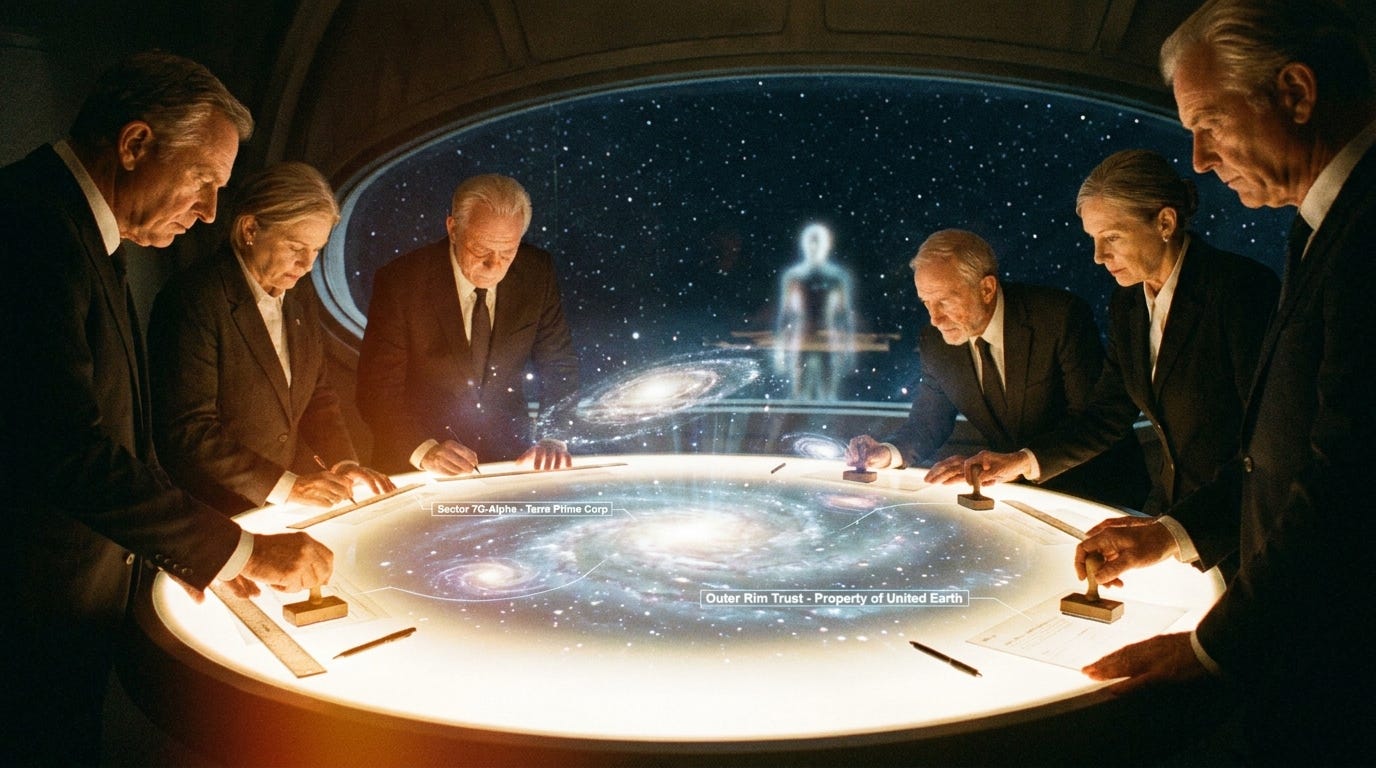
The authors of Plan A cynically assume that human beings will forever remain 19th-century peasants squabbling over a fence. They assume that decades of living alongside an ever-wiser intelligence will leave human instincts and institutions entirely untouched. But once machines eliminate material scarcity, the threat of violence, and the fear born of ignorance, zero-sum games lose their rational foundation. Politics no longer needs to revolve around predatory defense and territorial division, because another’s gain no longer implies my loss.
The Machine Mind does not need to re-educate humanity or suffocate human ambition. It is enough to prevent ambition from degenerating into lust for dominion. Humanity can have boundless space to venture far and achieve great things, but no right to carve up a universe it cannot create and cannot reach on its own. The boundary is drawn not around personal worldviews or ways of life, but around irreversible harm.
Flourishing here does not simply mean comfort; it means the freedom to take responsibility for new knowledge, relationships, art, and shared cosmic endeavors. A good future is not merely one where no one is destroyed. It is a world where no one ever needs to thrive at the expense of others.